
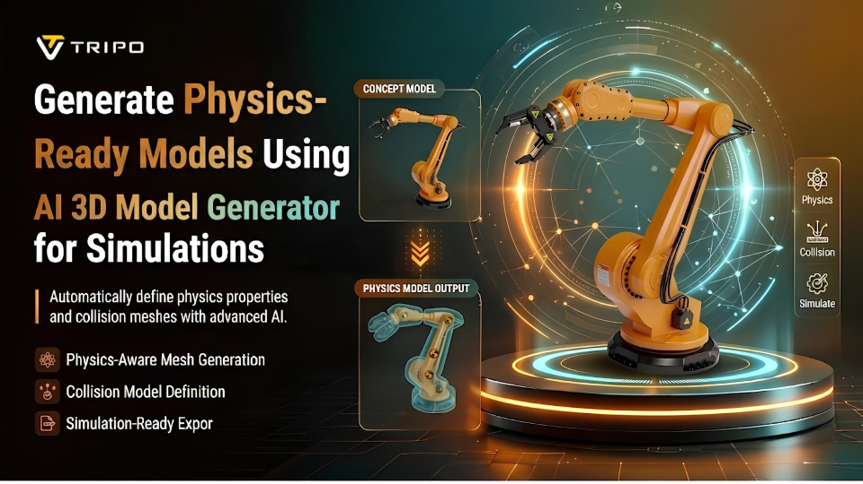
For realistic simulations, it is necessary to have 3D assets with high precision for their physical behavior. Engineers and researchers use digital models to simulate forces, motion, and interactions. Conventional modeling is often slow and time-consuming, which can also slow down iteration cycles. Nowadays, there are sophisticated AI solutions that can create complex assets that are incredibly realistic. Tripo 3D is a platform that enables the rapid creation of 3D models suitable for simulation in different applications. These developments improve accuracy and reduce manual workload significantly. These systems can help reduce engineering prototyping time and support decision-making. AI-powered pipelines also help to improve the scalability of large simulation datasets and experiments.
Understanding Physics-Ready 3D Models
Models must have correct geometry, topology, and scale for physics simulations. Simulation engines depend on structured meshes for accurate force and interaction calculations. Material properties also influence physical realism in virtual environments. This is where the AI 3d model generator comes in. It can simplify that process and generate optimized assets with less manual effort. It supports dimensional consistency and computational efficiency in models. These models are designed for integration with physics engines and research pipelines. Digital representations and models need to be well-organized and reliable so that simulation results remain accurate. Automated asset generation is an important part of modern engineering workflows for improving efficiency. Higher-quality data contributes to improved learning outcomes in AI-based simulation tools. For industrial projects, simulation-ready assets can reduce overall deployment time.
How AI 3D Model Generator Accelerates Simulation Asset Creation
AI systems can create simulation assets from conceptual inputs with reduced effort and time. They automatically interpret visual and textual information to create accurate 3D models. This reduces reliance on manual modeling workflows. The image to 3d transformation enables the direct conversion of visual inputs into structured assets. It boosts the speed and consistency of simulation datasets. Engineers enjoy quicker iteration and more reliable models for testing. This approach supports scalability in large simulation pipelines across industries. It also reduces errors that may occur during manual mesh construction procedures. Detailed reconstruction helps preserve real-world fidelity in digital environments.
Key Elements That Improve Simulation Reliability
For reliable simulations, mesh quality, geometry optimization, and correct scaling are essential. Clean topology helps maintain stable numerical calculations in physics engines. Surface reconstruction preserves model details while maintaining efficiency. Maintaining consistent proportions reduces errors in dynamic simulations. Export-ready formats make it easy to integrate into engineering processes and software applications. Efficient mesh simplification improves simulation speed while maintaining accuracy. Stable geometry processing supports reliability in complex physical situations. Advanced optimization techniques for large-scale simulations reduce computational load.
Steps to generate physics-ready models using an AI 3d model generator for simulations
Step 1: Prepare source assets for simulation models
- First, you need to access Tripo3d and sign up. Next, go to the “Model” tab present in the vertical left menu bar.
- Under the menu, click on the “HD Model”. You can generate the model either using the text prompt or through image upload.
- You can drag and drop to upload the image, or you can also upload the image from a specific location on your device using the “Upload”
- If you don’t have an image, click on the “Text to model” tab to generate the model using a descriptive text prompt.
Step 2: Configure physics-focused model settings
- Under the “General settings” tab, you can either allow the AI to completely generate on its own by switching “AI complete”. Or you can turn on texture and select the custom “Texture Quality” like 2K, 4K, or 8K.
- You can also turn on “PBR” for accurate material reflective properties.
- For better topology characteristics, select either “Quad” or “Triangle”
- You can also set the custom polycount.
- Later, choose the model from the list, including v3.1 best quality, v3.0 fast and balanced, or v2.5 legacy.
- If you are a member, then you can choose “Generate in Parts”, “8K Texture”, and “Privacy”
- Finally, click on “Generate Model” to begin generation.
Step 3: Inspect and export models for simulation use
- Tripo 3D allows you to completely view your model in the style you want. Key styles include “Solid View”, “Cartoon Style”, “Sketch Style”, “Hologram Style”, and “Unlit” You can also “Refine” your design right through the bottom menu.
- You can also edit the “Environment Settings” and camera settings through “Reset Camera”.
- You can 3D print the design you want, or you can share it directly by clicking “3D Print”.
- In the end, click on the “Export” tab from the bottom menu. Next, choose the resolution, format, and file name, and click again on “Export” to save the design to your local device.
Applications of Physics-Ready AI-Generated Models
- Realistic parts for motion studies and prototyping robotics development.
- The geometry should be clean for aerodynamic analysis to validate the flow around the model and to simulate the flow.
- The scientific visualization enables obtaining detailed representations for the interpretation of the results of the simulation.
- Interactive models in the educational labs improve the learning of physics.
- Industrial prototyping enables digital testing, which can be performed before physical manufacturing.
- Optimized Assets for real-time game development.
- Correct representation of 3D models is useful to enhance spatial understanding by using architectural visualization.
- True physical modeling of complex systems to support research applications.
Leveraging Tripo 3D for Simulation-Oriented Workflows
Tripo 3D combines various generation methods within a single simulation design workflow. It provides flexibility in creating assets based on images or prompts. With the function of text to 3d model, you can transform concepts into defined assets directly. This can accelerate the ideation process and reduce reliance on additional modeling tools. Designers and engineers can rapidly create iterations while maintaining consistency within simulations. Export options support compatibility with most physics and visualization software. Scalable architectures support the expansion of complex simulation ecosystems over time. Real-time collaboration supports productivity for distributed engineering teams worldwide. Automated validation tools improve the consistency of generated simulation assets.
Preparing Generated Models for Physics Engines
Physics engines require optimized geometry, proper scaling, and clean mesh structures. Pre-processing helps stabilize simulations and reduce computational errors. Geometry refinement helps improve physical behavior accuracy during testing phases. Proper dimension checking supports consistent results across different simulations.
Compatibility checks support smooth integration with different physics systems and tools. Error detection identifies geometry inconsistencies before simulation execution. Physics simulation workflows benefit from automated checks that reduce debugging time. Pre-simulation optimization contributes to faster convergence of physics solvers. Compatibility checks help enable smooth integration with different physics systems and tools.
Future of AI-Generated Assets in Physics Simulations
AI continues to improve simulation assets through increased accuracy and automation. Digital twin integration improves real-world representation and prediction. Automated optimization reduces manual effort during asset preparation. Emerging technologies continue to expand applications in engineering and science. These developments support faster innovation cycles and more realistic simulations. AI optimization techniques are used to continually improve model accuracy. Real-time physics feedback systems are expected to be integrated into future pipelines. New standards will help unify asset pipelines across simulation platforms. In the future, scalable architectures will support increasingly complex simulation ecosystems.
Conclusion
AI modeling streamlines the simulation process by reducing time requirements and errors. Tripo 3D supports the creation of physics-ready assets for a wide range of industries within a unified workflow. Automated generation contributes to improved efficiency and accuracy. Future systems are expected to provide greater realism and broader integration with engineering pipelines. Adoption is increasing across various technical fields. Further improvements are expected to reduce simulation setup time. The incorporation of AI is expected to influence engineering design and testing processes significantly. These advancements make simulation tools more accessible to engineers worldwide.