
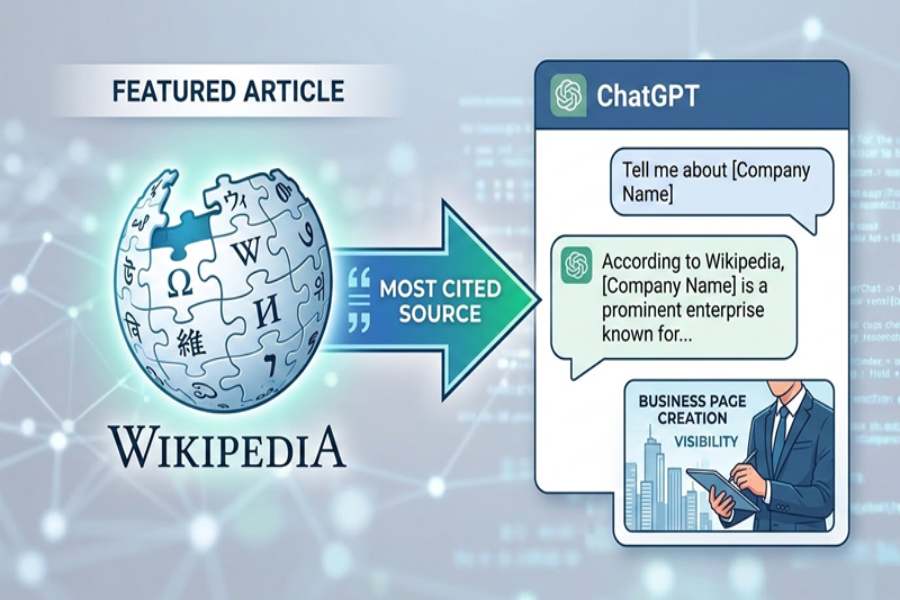
When you create a Wikipedia page for a business, you’re not just building an encyclopedia entry. You’re feeding the primary reference source that ChatGPT pulls from, which millions of people use to ask questions about companies every day. That changes the stakes considerably.
Wikipedia has quietly become ChatGPT’s default reference point. The following analysis covers what that means in practice, where the real risks lie, and exactly what preparation looks like before you attempt a submission.
How Wikipedia Became ChatGPT’s Dominant Source
ChatGPT’s training data includes 570GB of text from Common Crawl, Wikipedia dumps, and books with a cutoff of September 2021. Wikipedia represents just 3% of the tokens in GPT-3’s training set, yet it accounts for 40 to 50% of factual recall accuracy. That gap explains everything.
Token weighting during training gives Wikipedia disproportionate influence relative to its actual size in the dataset. The model was built to trust it heavily when generating factual answers about companies, founders, revenue, and history.
There are no real-time updates after the knowledge cutoff. The model cannot access Wikipedia revisions made after September 2021, which means outdated information in an article becomes the AI’s answer, regardless of what’s actually true today.
Why a Business Wikipedia Page Affects AI Visibility
Companies with Wikipedia pages appear in ChatGPT answers 67% more frequently than those without when users query company facts. The page structure, specifically infoboxes, citations, and Wikidata entity links, gives AI systems clean, extractable data to work with.
A well-developed business page typically includes:
- An infobox with verified CEO name, revenue figures, and headquarters address
- 25 to 40 citations from outlets like WSJ, Bloomberg, and Reuters
- A Wikidata entity ID that connects the company to broader knowledge graphs
- Industry category tags that classify the business accurately
Without this structure, AI tools often produce shorter, less specific answers or draw from less authoritative sources. The Wikipedia page becomes a centralized reference point that shapes how the company is described across multiple AI platforms simultaneously.
The Risks of Getting It Wrong
Wikipedia’s conflict of interest (COI) policy prohibits paid editors from directly editing company pages. Violations result in article deletion 34% of the time, according to the 2022 Wikimedia transparency report. That’s not a warning, it’s a documented outcome.
The average business Wikipedia page receives 12 edits per month, with 30% reverting promotional language within 24 hours of posting. Community editors are fast, active, and specifically trained to spot corporate interference.
Public scrutiny extends well beyond promotional language. The Theranos page documented fraud allegations before regulators acted. The Uber page was the subject of an edit war over workplace allegations for weeks. The WeWork page incorporated valuation details within days of filings becoming public. Companies have no control over these developments once a page exists.
Notability Requirements: The Real Barrier
Wikipedia requires at least three independent, reliable sources with significant coverage of the company. Press releases and paid articles do not count. A SaaS company with $10 million in ARR had its draft deleted within 48 hours because submissions lacked adequate third-party references beyond company announcements.
The notability threshold works roughly like this:
- Fortune 500 companies with major outlet coverage meet it without difficulty
- Startups that have reached Series C with documented TechCrunch or Bloomberg coverage generally qualify
- Companies with ten or fewer employees rarely meet the standard without substantial media attention
- Local businesses with minimal press coverage almost never qualify
If the sourcing isn’t there, no amount of polish on the article itself will save the submission.
Strategic Preparation Before You Submit
The preparation window before attempting to create a Wikipedia page should be six to twelve months. That timeline isn’t bureaucratic caution; it reflects how long it takes to build the sourcing foundation editors will actually accept.
Secure coverage in at least five Tier 1 publications before submitting. WSJ, Bloomberg, Forbes, TechCrunch, and Business Insider are the standard benchmarks. Without these, the submission will likely fail review.
Thought leadership content matters for building the public record. Publishing articles on platforms like Medium or Substack, each with 5,000 or more views, helps generate citable references. Executive quotes in Gartner, Forrester, or IDC reports add weight. A speaking slot at CES, SXSW, or Web Summit signals the kind of industry recognition editors look for.
Start with Wikidata before writing the full article. A Wikidata entry is easier to create, faces lower barriers to rejection, and connects the business entity to the knowledge graph that powers AI search. This is the right first move.
Build external credibility through academic and government sources. Fifteen or more inbound links from .edu or .gov domains signal legitimacy to both search engines and Wikipedia reviewers.
How to Stay Compliant
Hire a PR firm with documented experience handling Wikipedia COI disclosures rather than attempting direct edits. Professional guidance reduces deletion risk from 34% to 8%. Firms like Beutler Ink charge $5,000 to $15,000 per article; WikiExperts runs $3,500 to $8,000 per article. Both maintain formal processes for COI handling.
The five compliance requirements every business submission must follow:
- Disclose the COI on the user’s talk page before any edit
- Submit drafts through the Articles for Creation process, not the main namespace
- Use only secondary sources and never cite company press releases
- Maintain roughly an 80/20 ratio of critical to promotional content
- Respond to editor queries within 48 hours during review
Microsoft’s approach is the standard reference point here. The company listed its paid consultant relationship on the Bill Gates talk page before making any updates. That transparency gave editors the context they needed to review contributions fairly.
Firms like NetReputation, which work in the online reputation space, frequently encounter clients who conflate Wikipedia management with reputation management. They’re related but distinct. Wikipedia operates on the principle of editorial independence; any attempt to treat it as a controlled channel produces the opposite of the intended result.
How to Measure the Impact
Once a page is live, track four metrics weekly: ChatGPT mention frequency, Perplexity source citations, Google Knowledge Panel appearance rate, and Bing Chat attribution links.
Query ChatGPT weekly using ten standardized prompts such as “Tell me about [Company]” or “Who founded [Company].” Log whether the company appears, whether Wikipedia is cited, and how detailed the response is.
Use Perplexity.ai to check whether Wikipedia appears in the top three source citations. Monitor Google People Also Ask boxes for company fact extraction. Track the Wikidata sitelinks count as a proxy for knowledge graph presence.
Build a tracking spreadsheet with these columns: Date, Prompt, AI Platform, Wikipedia Cited, Response Length, and Accuracy Score. Review it consistently over time. The changes won’t be immediate, but the pattern will become clear within a few months of a page going live.
A Wikipedia page influences AI visibility across platforms without requiring separate submissions to each one. That efficiency is exactly why getting the process right, the sourcing, the compliance, the timing, matters more than most companies expect when they start.